
If you’ve spent any time around AI forums (or X, or Reddit, or your group chat with that one friend who won’t stop talking about local LLMs), you’ll have noticed a pattern. A big new model drops, headlines call it “open source,” everyone gets excited, and then a few days later someone points out that it’s actually released under a custom licence with a bunch of restrictions attached. Rinse and repeat every few months, with a different model each time.
The word doing all the heavy lifting in these headlines is usually “open weight,” quietly standing in for “open source” as if the two mean the same thing. They don’t, and hopefully this article will explain the differences in an easy to understand way! It actually changes what you’re legally and practically allowed to do with a model.
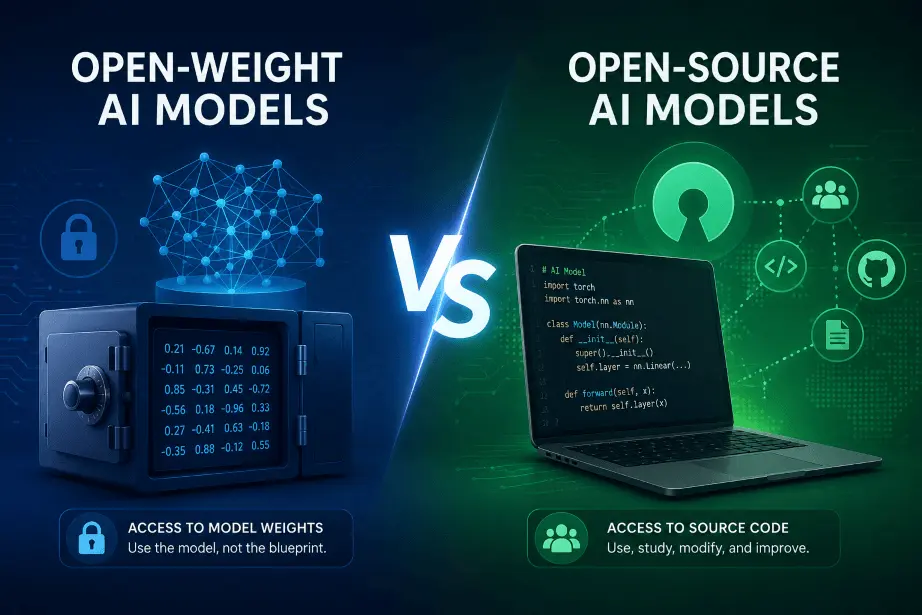
The quick version
Open weight means the company hands you the finished, trained model file and says “here, run this.” You can download it, use it, build products on top of it, sometimes even fine-tune it a bit. What you usually don’t get is the training data, the full training code, or a licence that lets you do absolutely anything you want with it.
Open source (in the strict sense) means you get all of that AND the recipe behind it: the code used to train it, real information about what data went into it, and a licence that grants you genuine freedom to use, study, modify, and share the whole thing, no strings attached.
Every open-source model is open-weight. Not every open-weight model is open source. That’s the whole confusion in one sentence!
The cake analogy
Think of a trained AI model like a really elaborate cake.
An open-weight release is like a bakery handing you a finished, beautifully decorated cake. You can absolutely eat it. You can serve it at your own party, sell slices of it, maybe even scrape off the frosting and try adding your own sprinkles. But you don’t know exactly what’s in it. You don’t have the recipe, you don’t know the ratio of flour to sugar, and you definitely can’t reproduce it from scratch in your own kitchen. If the bakery decides tomorrow that you’re not allowed to sell slices commercially, or that you owe them a cut once your bakery gets big enough, well, that was probably buried in the terms you agreed to when you picked up the cake.
An open-source release gives you the cake, the full recipe, the ingredient list, and permission to bake as many copies as you like, tweak the recipe however you want, and hand it out to whoever you please. Nobody’s coming back later to ask for royalties once your version takes off.
Most of the big, headline-grabbing model releases you’ll hear about are very much the first kind of cake. Genuinely impressive! Just not ones you can bake yourself.
Real examples, without the hype cycle
This isn’t a hypothetical distinction, it plays out over and over with real releases. Meta’s Llama models are a classic case: widely downloadable, genuinely useful, and constantly described online as “open source,” while actually sitting under a licence with its own commercial carve-outs and restrictions once you hit a certain scale. Moonshot AI’s Kimi models have followed a similar shape too, released as open-weight with a custom licence rather than one of the standard, pre-vetted open-source licences.
Neither of these is a dig at the companies involved, to be clear. Writing a custom licence with some commercial strings attached is a perfectly reasonable business decision. It just doesn’t meet the technical definition of open source used by the Open Source Initiative (OSI), the organisation that maintains the closest thing the industry has to an official rulebook here. OSI’s Open Source AI Definition asks for three things: usable training code, meaningful detail about the training data, and weights released under a licence that’s actually been vetted and approved as open source. A custom licence with its own restrictions doesn’t clear that bar, no matter how generous it is in practice, and this pattern shows up again with pretty much every major model release.
So who’s actually doing “real” open source?
Projects like AllenAI’s OLMo models or EleutherAI’s Pythia models are much closer to the strict definition: they publish the training code, describe the training data in real detail, and release everything under licences anyone can freely build on and redistribute. They tend to get a fraction of the attention that flashy frontier models get, partly because full transparency about training data is genuinely expensive and legally risky for a company to commit to, especially at the scale of a model with trillions of parameters.
Does it actually matter?
If you’re just chatting with a model through an app, none of this changes your day. But it matters a lot if you’re:
- A developer or business planning to build a product on top of a model. That custom licence could mean fees, revenue caps, or restrictions you won’t find out about until your product actually takes off.
- A researcher trying to understand why a model behaves the way it does. Without training data details, you’re stuck reverse-engineering behaviour rather than actually studying it.
- Someone who cares about AI transparency in general. Weights alone tell you very little about what a model learned from or how it was built. That’s a genuine, ongoing debate in the AI world, not a minor footnote.
A quick gut check
Next time you see “open source AI model” in a headline, ask yourself:
- Can I download the training code, not just the finished model?
- Is there real detail about the training data, or just vague marketing language?
- Is the licence one that’s actually been vetted as open source, or a custom one the company wrote itself?
If the answer to any of those is no, you’re most likely looking at an open-weight model wearing an open-source label. Which is still completely fine! Open-weight models are genuinely useful and often free to use in all the ways that matter for most people. We just wanted to help clear up the air around these two similar terms, especially as there appears to be such an influx of open weight models releasing as of late.

