
Google Prompting Essentials
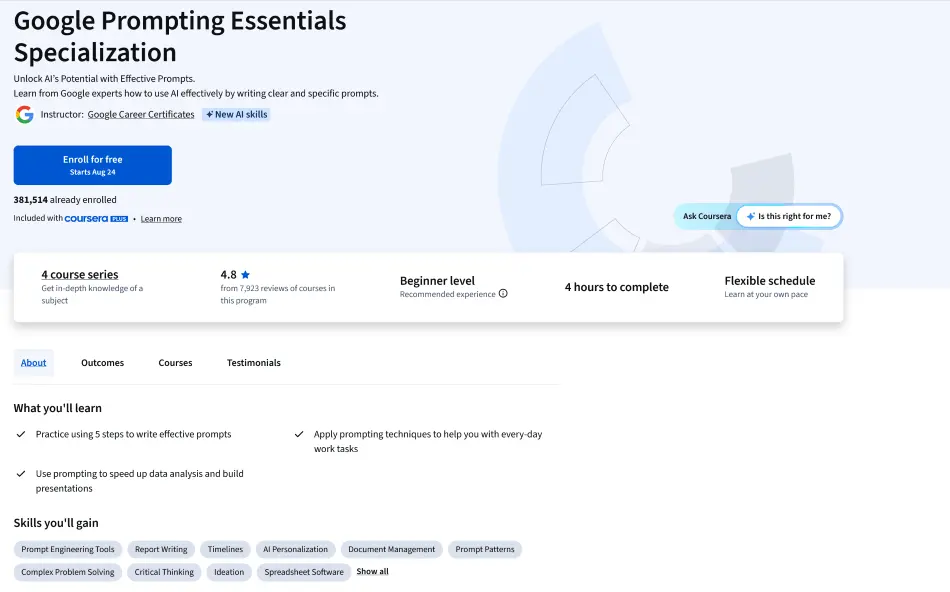
- Category - Prompting
- Course Difficulty - Easy
- Course Length - 4 Hours
- Price - 7-day free trial, then $49 per month
- Rating
4.5/5
Most people who use AI tools like Gemini or ChatGPT are only scratching the surface of what these systems can actually do, mainly because they haven’t learned how to ask for what they want in the right way. Google Prompting Essentials, a specialization offered through Coursera, was built to fix exactly that gap. Rather than diving into technical jargon or coding, it teaches a simple, repeatable framework for writing prompts that get better results, whether you’re drafting an email, digging through a spreadsheet, or trying to make sense of a mountain of data. Designed by Google’s own AI experts and already taken by well over 380,000 learners, the program has earned a strong reputation for turning AI from a novelty into a genuinely useful daily tool.
Subjects Covered
- The fundamentals of prompting and how it differs from simply typing a question into an AI chatbot
- A five-step prompting framework covering task, context, references, evaluation, and iteration
- Prompt patterns and context engineering techniques
- Writing prompts for everyday work tasks such as emails, brainstorming, tables, and timelines
- Adjusting tone and style in AI-generated text output
- Using AI to speed up data analysis, fix spreadsheet formulas, and build data visualizations
- Responsible AI practices, including how to spot bias and errors in AI outputs
- Prompt chaining and chain-of-thought prompting for more complex, multi-step tasks
- Meta-prompting and prompt versioning for reusing and refining prompts over time
- Multimodal and few-shot prompting techniques
Course Features
The specialization is broken into four short courses, each focused on a different practical use case, so learners can build up their skills gradually rather than being thrown in at the deep end. The first course lays the groundwork with the core prompting framework, while the later courses apply that framework to specific scenarios such as everyday office tasks, data analysis, and more advanced creative or expert-style AI collaboration. Throughout the program, learners complete hands-on activities using real generative AI tools, including Gemini and Google AI Studio, and the techniques taught are designed to transfer easily to any other AI model. One nice practical touch is that learners build a personal library of reusable prompts as they go, along with a takeaway worksheet, so the skills don’t just stay in the course but carry over into actual day-to-day use. The whole thing is self-paced and delivered entirely online, with content available in English and a growing number of additional languages.
Key Learning Outcomes
By the end of the specialization, learners should be able to:
- Apply a clear, five-step process for writing effective prompts to any generative AI tool
- Use prompting techniques to handle everyday work tasks like writing, summarising, and organising information
- Speed up data analysis work and build presentations with AI assistance
- Evaluate AI-generated outputs for accuracy, bias, and overall usefulness
- Refine and iterate on prompts to consistently get better results
- Apply more advanced techniques such as chain-of-thought reasoning and meta-prompting to tackle complex, multi-step problems
Target Audience
Google Prompting Essentials is aimed at complete beginners, so no prior AI or technical experience is required to get started. It’s a good fit for professionals across virtually any industry who want to use AI tools more effectively in their day-to-day roles, as well as students, job seekers, and anyone simply curious about getting more value out of tools like Gemini. It’s worth noting that this program focuses on practical, everyday prompting skills rather than preparing learners for a dedicated prompt engineering career, so those looking for a deeper technical specialisation may want to pair it with a more advanced course further down the line.
Accreditation
The specialization is developed and taught by Google Career Certificates, and learners who complete all four courses earn a certificate directly from Google. This certificate can be shared on LinkedIn or included on a resume or CV to demonstrate practical AI competency to current or future employers. While the program doesn’t carry standard university credit, some institutions may choose to recognise it, so learners planning to use it toward academic credit should check directly with their school. It’s also part of Google’s broader family of Career Essentials programs, which are designed to help learners build in-demand skills quickly without committing to a longer certificate track.


Links
Copyright © 2026 EasyWithAI.com
Thank You
Readers like you help support Easy With AI. When you make a purchase using links on our site, we may earn an affiliate commission at no extra cost to you.